Industry Report Q1 2026: Gastronomy & Hospitality in Germany – Figures, Trends and Outlook

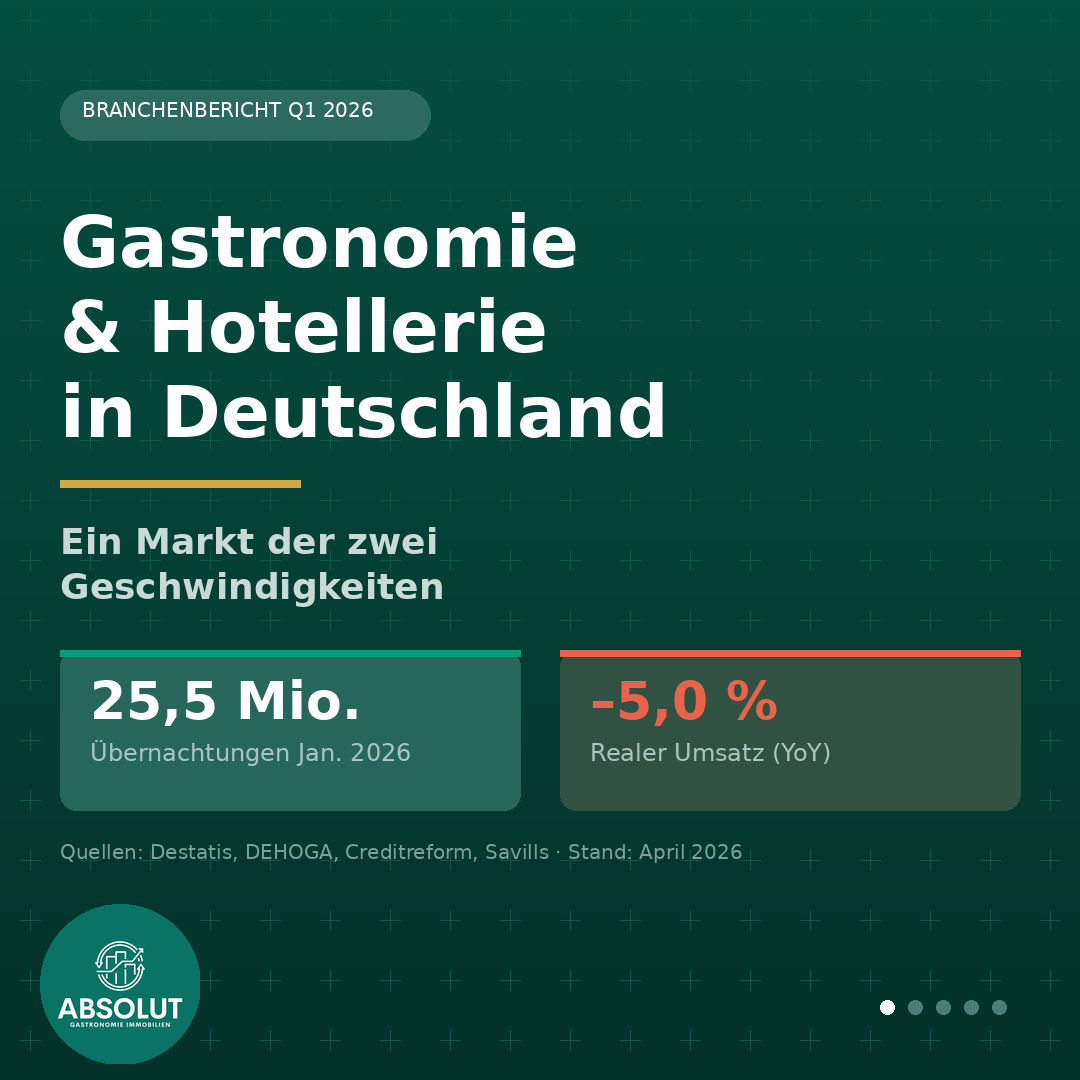
The first quarter of 2026 is characterised by a growing divide between accommodation demand and actual revenues. Whilst tourism is growing moderately, inflation is eroding the real earnings of operators — the sixth consecutive year of losses for the hospitality sector.
1. Macroeconomic Indicators (January 2026)
According to the Statistisches Bundesamt (Destatis), a total of 25.5 million overnight stays were recorded in Germany in January 2026 — an increase of 1.2% compared with the same month of the previous year. Domestic guests rose by 1.3% to 21.2 million, whilst international guests increased by 1.0% to 4.3 million.
Despite rising prices, real hospitality revenue fell by 5.0% in January 2026 compared with the prior-year month, whilst nominal revenue increased by 2.0%. Compared with the pre-crisis year of 2020, the real revenue loss stands at –19.2%.
The restaurant and catering sector recorded a real revenue decline of 5.9% in January 2026 (nominal: +2.4%). Labour costs +34%, food costs +27%, energy +28% since 2022. Hotels: real –2.8% (nominal: +1.4%), supported by the MICE sector.
2. Restaurants and Catering vs. Hotels: Two Speeds
19.3% rated conditions as good, 43% as satisfactory, 26% as poor. Top burdens: staff costs 75.2%, bureaucracy 67%, energy 65.7%. 72.1% have been unable to invest since 2022.
3. DEHOGA (German Hotel and Restaurant Association) Sentiment & Pressure Factors
Over 11,200 restaurant and catering insolvencies since 2020, plus 69,000 silent business closures. 108 insolvencies per 10,000 businesses — the second-highest rate of any sector (Destatis). Experts anticipate a further increase in 2026.
4. Wave of Insolvencies: 2,905 Restaurant and Catering Failures in 2025
Transaction volume Q1 2026: €163 million (Savills). Hotels 80%, Serviced Apartments 18%. Limehome: 90% occupancy, 25% operating costs. The market is projected to grow from USD 2.8 billion to USD 5.1 billion by 2033.
5. Serviced Apartments: 18% of Investment Volume, 90% Occupancy
Whilst the hotel sector is generating volume growth, the restaurant and catering industry is contending with its sixth consecutive year of real losses. The reduction in VAT to 7% provides some relief, though this is offset by rising costs. For investors, Serviced Apartments offer the most favourable outlook.
Conclusion: A Two-Speed Market
Sources: Destatis, DEHOGA Bundesverband, Creditreform, Savills Deutschland, mrp hotels, CBRE Germany.
- Industry Reports