Half-year report 2026: German hospitality between record and margin pressure
223.8 million overnight stays and yet declining real revenues. What the price gap means for operators, owners and buyers of hospitality and hotel properties.
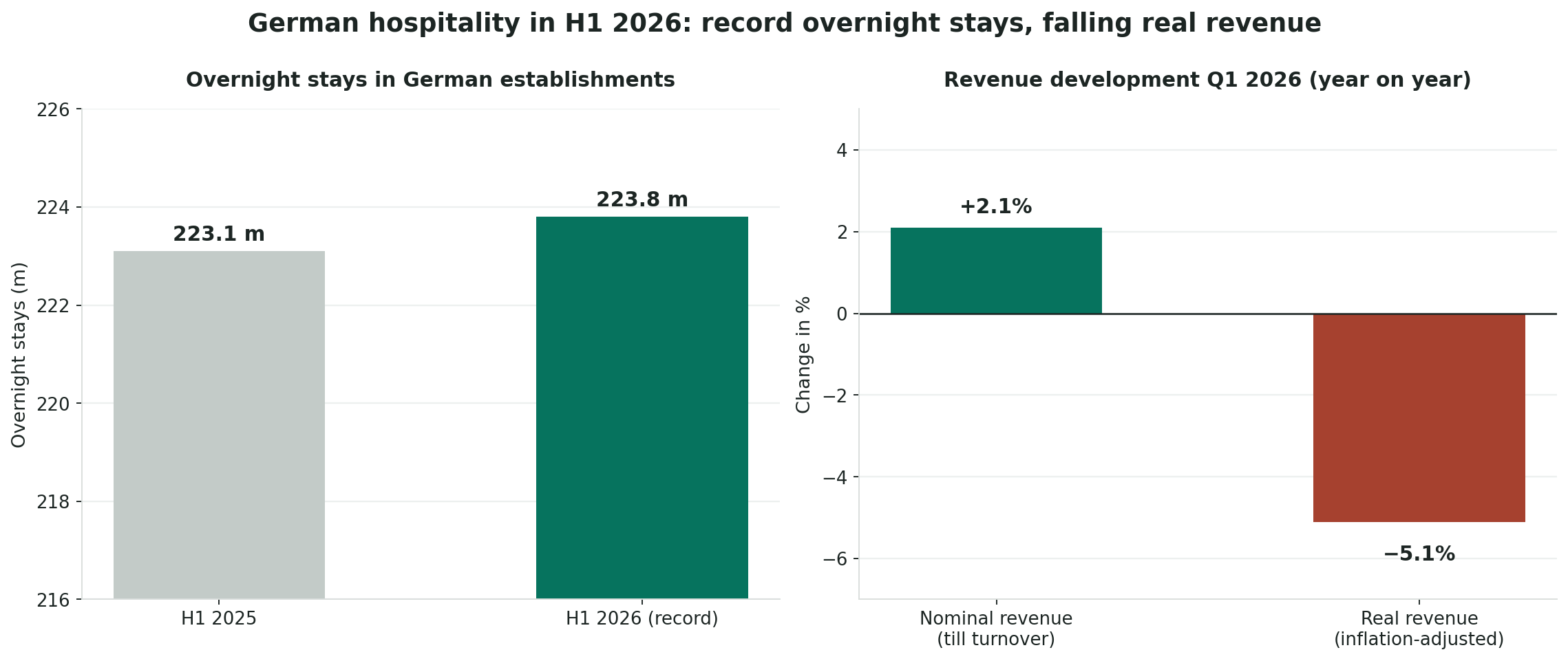
The first half of 2026 delivers a record at first glance and a warning at second. Overnight stays reached a new high of 223.8 million, yet in real terms – once price increases are stripped out – revenue fell markedly. Anyone looking only at volume misses that the sector is running into a ceiling.
Key points
- 223.8 million overnight stays in the first half, up 0.3 per cent – while room occupancy stagnates at 60.4 per cent.
- In the first quarter, a nominal revenue increase of 2.1 per cent stands against a real decline of 5.1 per cent. In April the gap widened further: up 0.9 per cent nominal, down 7.1 per cent real.
- Around 15,000 insolvencies in German hospitality in 2025, an increase of 15 per cent – the steepest rise across all sectors examined.
- Costs have risen sharply since 2022: goods by 27.1 per cent, energy by 27.6 per cent, staff by 34.4 per cent.
- With net margins between 1.7 and 2.8 per cent, there is virtually no room for operational error.
The pricing gap: growth that isn't
The sector's nominal growth is now almost entirely price-driven. Visitor numbers stagnate; till turnover rises only because prices rise. That marks the point at which further increases cost footfall directly: the guest comes less often rather than paying more.
For operators this shifts the priorities. As long as price increases worked, cost pressure could be passed on. That route is closed. What remains is control of one's own cost structure – and that is where it will be decided which businesses come through 2026.
The benchmarks that matter
| Metric | Target range |
|---|---|
| Cost of goods | 28 to 35 per cent |
| Staff costs (full service) | 36.5 per cent (median) |
| Prime costs (goods and staff combined) | 60 to 65 per cent |
| Net margin (German average) | 1.7 to 2.8 per cent |
Anyone above these figures has a cost problem, not a pricing problem. And anyone who does not know their figures at all, because items are booked as open entries at the till, lacks even the basis to correct course.
Where it works: chain catering and snackification
Chain catering is proving a stable anchor: 41 per cent market share, 36 billion euros in revenue, up 4 per cent. Quick service benefits particularly with a 48 per cent share of spending, while delivery services grew by 10 per cent.
One margin driver is easily overlooked: alcohol-free beer now accounts for 12 per cent of beer volume in hospitality. Lower duty makes the margin attractive – a trend that can be captured without investment.
Accommodation: domestic guests carry the market
Of the 223.8 million overnight stays, 187.4 million were domestic guests, or 83 per cent. The international market remains below pre-crisis levels at 36.4 million. The German guest is therefore not merely the majority but the actual stabiliser.
Occupancy stagnating at 60.4 per cent alongside record overnight stays does indicate overcapacity in some segments. More guests are spread across more beds.
Business travel: more trips, less yield
Business travel has returned in volume terms, up 8.3 per cent on the previous year. Yield per guest is falling, however: average spend per trip stands at 418 euros, down 4.8 per cent. For hotels this means the return of business travellers is worth less than the headline figure suggests.
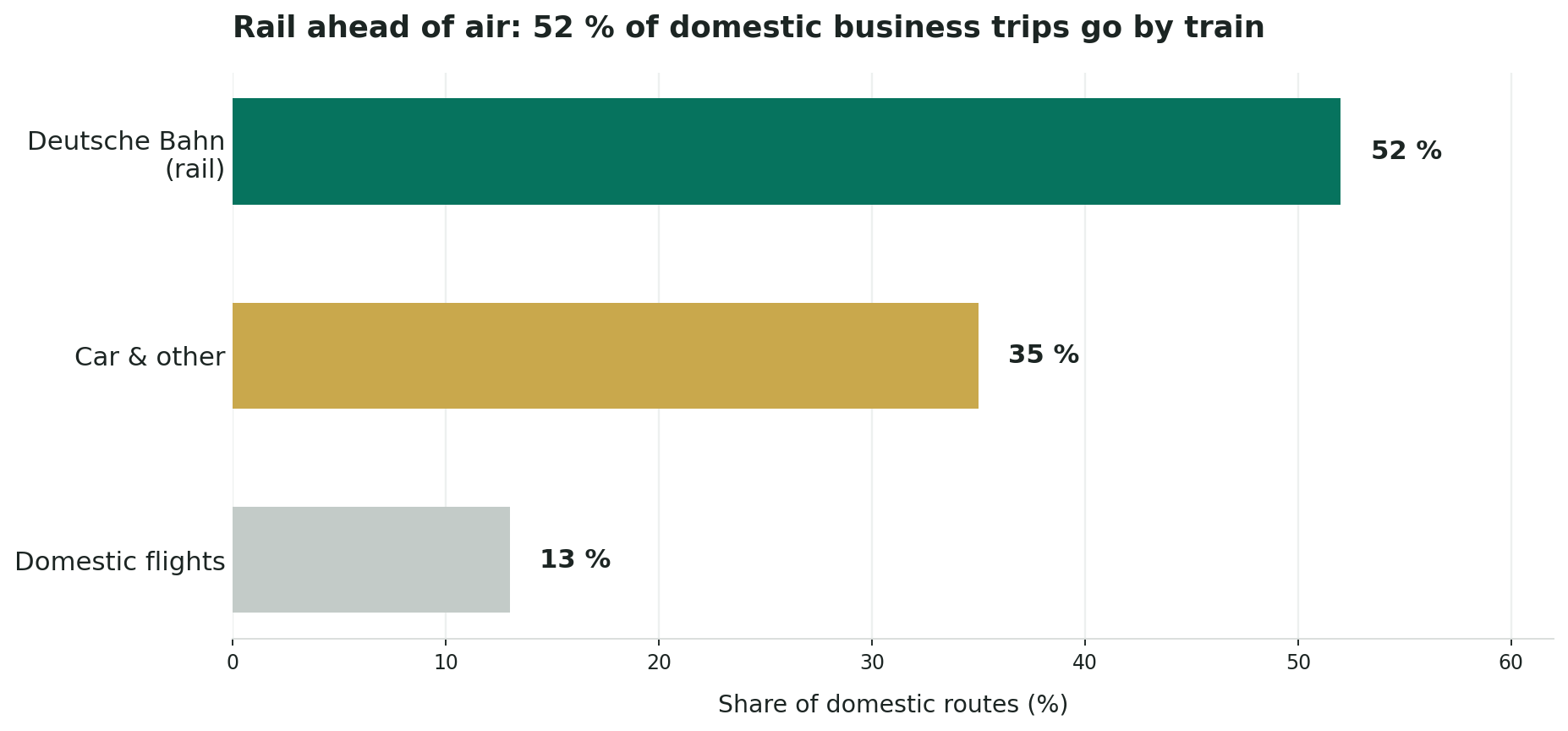
The shift in transport mix matters more for location questions than it first appears: 52 per cent of business travellers use rail, only 13 per cent domestic flights. Properties near stations gain; airport locations without rail links lose – a development worth factoring into acquisition and valuation.
Seventy-five per cent of business travel volume is carried by small and medium-sized enterprises. That is a defensive wall against global crises, but no certainty: shrinking travel budgets make this growth fragile.
Zero-click: how AI search changes booking
One development barely visible in the figures yet gaining ground quickly: guests increasingly plan through AI assistants that surface recommendations directly, without the user opening a website at all. Properties whose information is not cleanly structured and machine-readable simply do not appear in those recommendations – however good they are.
What counts in 2026
What to get right
- Measure food cost rather than estimate it. Reducing food waste offers a seven-to-one return: every euro invested saves seven in costs.
- Flexible cancellation as a selling point. Seventy per cent of guests prefer flexible terms. That can be used to raise direct booking rates.
- Sustainability as a precondition for contracts. Large corporate clients increasingly require carbon data. Those who cannot supply it drop out of tenders.
- Technology against staff costs. Combi steamers and modern dishwashing shorten processes and absorb part of the pressure on staff costs.
What backfires
- Replacing service with QR codes. Digitalisation should relieve staff, not isolate the guest.
- Static pricing. Without dynamic adjustment you give away margin at peaks and occupancy in quiet periods.
- Sloppy till entries. Open items destroy the data basis for any analysis.
- Hidden charges. In a price-sensitive market they lead to immediate loss of custom.
What this means for owners and investors
For the valuation of hospitality property the focus shifts. Nominal revenue figures say less in 2026 than ever before – what matters is how a business controls its cost structure and whether its figures grew in real terms or merely through pricing.
For sellers this means solid accounts for recent years have become more important, because buyers and their banks look more closely. For buyers it means, conversely, that a business with a clean cost structure and documented metrics is worth a premium.
How the value of a property is composed in detail is set out here: What is my hospitality property worth?
Conclusion
The demand is there – the overnight record shows that. What is missing is the margin. 2026 will not be decided by guest numbers but by cost control. Businesses that know their figures, price dynamically and have their processes in hand will come through. Those that continue to rely on price increases will lose the guests they need to survive.
If you are considering selling, leasing or expanding, we are glad to discuss your particular situation. The initial consultation is free of charge and confidential.
Sources: German Federal Statistical Office, DEHOGA, own market observation. As at: first half of 2026.