Half-year balance sheet 2025 in the catering industry

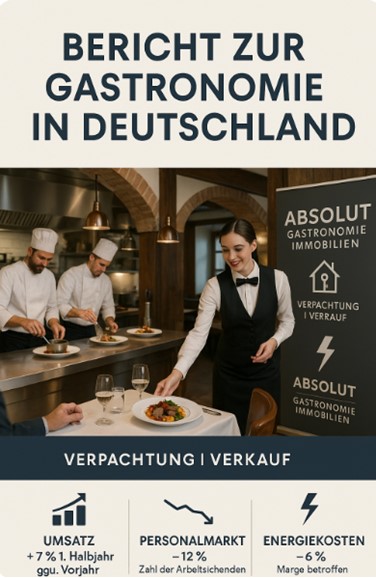
The 2025 half-year results for the hospitality sector summarised in 3 figures. 1) The Half-Year Review – Revenue Comparison: H1/2025 vs H1/2024. Current performance in 2025 (Jan–May):
1) The Half-Year Review – Revenue Comparison: H1/2025 vs H1/2024
Following a gain in January (+2.7% in real terms vs December), real revenues declined in February (-1.7%), March (-1.3%), and fell sharply in May (-4.6% vs the previous month; -4.0% vs May 2024). April was down -1.0% in real terms vs April 2024. Overall, figures through to May point to a real-terms decline compared with H1/2024. Final H1 figures are not yet available.
Source: Statistisches Bundesamt
Comparison with 2024 (full year):
In 2024, the hospitality sector closed -2.6% in real terms year-on-year (nominally +0.6%). Pricing levels therefore remained a problem; the sector did not recover to 2019 levels in real terms.
Source: Statistisches Bundesamt
Gap relative to 2019 (pre-pandemic):
Even at the end of 2024, real revenues remained significantly below 2019 levels (e.g. November 2024: restaurant sector -17.1% in real terms vs November 2019). The H1/2025 picture (through to May) confirms that real revenues remain well below pre-crisis levels.
Source: Statistisches Bundesamt
2) Labour Market (Skilled Workers & Employment)
Vacancies / Shortage:
The BA (Bundesagentur für Arbeit – Federal Employment Agency) reported approximately 33,000 vacancies in the hotel and hospitality sector in 2024. In the 2025 half-year review for the hospitality sector, the skills shortage (Fachkräftemangel) statistically eased – not because the sector suddenly became well-staffed, but because demand fell. Many operators continue to reduce opening hours.
Source: Bundesagentur für Arbeit, DIE ZEIT
Training & Trends:
According to the IAB (Institut für Arbeitsmarkt- und Berufsforschung – Institute for Employment Research), new apprenticeship contracts stagnated or declined in 2024; unfilled training places remain an issue – exacerbating the staffing gap in the medium term.
Source: IAB documentation
Price Levels & Framework Conditions
3) Energy Prices & Impact on Margins
The energy price brakes for electricity and gas expired on 31 December 2023. In 2025, producer prices are marginally declining overall, but service sector prices (driven partly by personnel, materials and energy costs) rose by +2.8% year-on-year in Q1/2025. For commercial and industrial consumers, BDEW analyses show that electricity and gas prices in 2024/25 are below the extreme levels seen in 2022, but remain above 2019 levels – some relief, yes, but no return to the previous norm. Result: margin pressure remains high.
Source: WVV, Statistisches Bundesamt, BDEW
Industry Feedback:
In DEHOGA (Deutscher Hotel- und Gaststättenverband – German Hotel and Restaurant Association) surveys in 2024/25, operators cite energy costs (≈71%), personnel and food and beverage costs, and the return of VAT to 19% as the principal burdens. Combined effect: higher costs are meeting price-sensitive guests → margins are being squeezed.
Source: HOGAPAGE
4) Insolvencies in the Hospitality Sector
Situation in 2024/25 (economy-wide):
Formal insolvency filings have been rising again since 2023 – June 2025: +2.4% vs the same month in the prior year. According to Destatis (Statistisches Bundesamt), the hospitality sector (Gastgewerbe) consistently ranks among the most severely affected segments.
Source: Statistisches Bundesamt
Rates & Context:
In 2024/25, the hospitality sector ranked among the highest for insolvencies per 10,000 businesses (alongside construction and transport). Regional official statistics support this trend. Conclusion: case numbers are rising, albeit at varying rates by federal state and type of establishment.
Source: Statistisches Bundesamt, Statistik Nord
5) Number of Businesses (Structural Change)
VAT-registered businesses in the hospitality sector:
Total in 2023: 202,110 (2019: 222,442) – representing approximately -9% vs pre-pandemic levels. Particularly sharp declines were recorded in, for example, Schankwirtschaften/Kneipen (bars and pubs) (2019: 28,808 → 2023: 21,815; approximately -24%). Restaurants stood at 65,919 in 2023, still below the 2019 figure of 70,619 (approximately -7%). *Source: Destatis (VAT statistics), compiled by DEHOGA (as at March 2025).
Source: DEHOGA Bundesverband

Download Report:
- Hospitality sector financial results
- Hospitality
- Insolvencies in the hospitality sector
- H1/2025
- Hospitality sector figures